
Innovator: John Fitch
The Fitch Fuel Catalyst named after John Fitch.
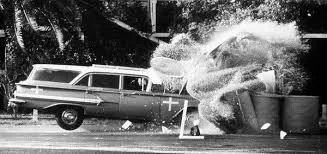
Road Crash Barriers
Invented by John Fitch

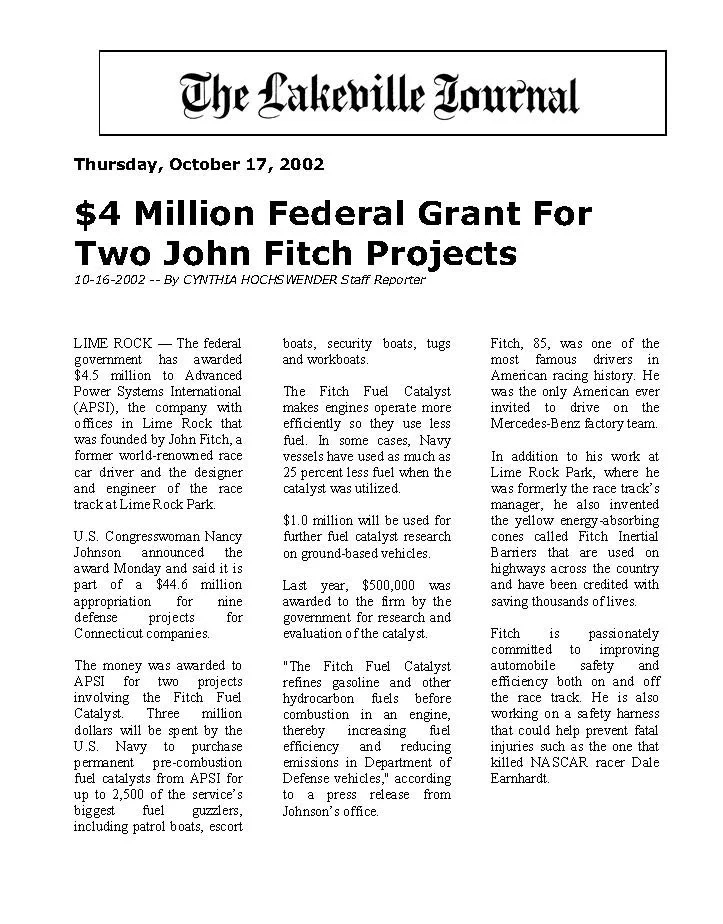
John Cooper Fitch was an American racing driver, war hero, and inventor whose career bridged top-level motorsport and practical safety innovation. He scored major sports-car racing victories in the 1950s, including the 12 Hours of Sebring in 1953, a class win in the 1955 Mille Miglia, and success in the RAC Tourist Trophy, while also driving for Briggs Cunningham’s Le Mans efforts and later the factory Mercedes-Benz sports-car team. He led Chevrolet’s first Corvette racing team, managed the Lime Rock Park circuit after retiring from full-time driving, and became widely respected as part of the first great generation of American sports-car racers.
Away from the cockpit, Fitch turned his attention to safety and engineering, developing a series of highway and racing safety devices after witnessing and experiencing serious crashes. He is best known for the Fitch Inertial Barrier, the familiar clusters of sand-filled yellow plastic barrels at highway exits and bridge abutments that slow and cushion out‑of‑control vehicles, a system credited with saving many thousands of lives. Beyond barriers, his patents and concepts included guardrail systems, impact attenuators, and driver safety capsules, underscoring his determination to apply racing lessons to everyday road safety.
Fitch’s name also lives on through the Fitch Fuel Catalyst, explicitly named in his honor, recognizing him as a founding partner of Advanced Power Systems Int’l Inc., the manufacturer of the Fitch product line. John Cooper Fitch entrusted his name to the Fitch Fuel Catalyst only after personally installing and testing it in his own cars, and he did so because he genuinely believed in the underlying fuel‑reforming technology and its benefits. In marketing materials and technical descriptions, the company links the catalyst’s goals - better engine performance and reduced pollution—to Fitch’s long-standing identity as a racer‑engineer and innovator who sought both speed, safety and practical improvements for the ordinary driver.
The Patented Fitch® Fuel Catalyst technology is a true catalyst, not a consumable additive requiring replenishing with every tank of fuel. As diesel, fuel oil, propane, gasoline and natural gas is exposed to this proprietary metal alloy, the fuel’s molecular structure is modified at ambient temperature to enable more efficient energy release during combustion, allowing engines and equipment to extract more usable energy from every gallon of the fuel while reducing emissions and operating costs. The catalyst stimulates oxygenation, coupling and olefin formation while simultaneously promoting aromatic ring decomposition which leads to more complete and efficient combustion of the fuel. This allows engines to use less fuel for the same work while reducing emissions, engine maintenance, and downtime, and improving overall performance.
Because the Fitch Fuel Catalyst promotes more complete and efficient combustion, there is less unburned residue remaining on internal engine components and in the exhaust stream, commonly observed as emissions. As a result, greenhouse gas output and other pollutants are significantly reduced and there is less wear on the engine.
APSI serves a broad range of markets, from power sports enthusiasts (motorcycles, ATVs, and snowmobiles) to commercial and residential heating (furnaces and boilers), to mining and construction equipment, powerplants, as well as the automotive and the commercial and recreational marine sectors.
APSI’s products are sold both directly and through an established network of third‑party distributors and resellers to these segments. APSI’s technologies are installed on hundreds of thousands of applications worldwide, with customers including numerous Fortune 500 companies, the U.S. Navy, the Air Force National Guard, and a wide range of municipal and state agencies. In the New York City heating market alone, APSI’s solutions are installed on more than 1,000 schools and large commercial and residential buildings. More than 25,000 Fitch Fuel Catalysts are in service in commercial and industrial applications, and well over 500,000 customers use the Fitch Fuel Catalyst on their ATVs, snowmobiles, motorcycles, cars, and trucks.